The science ofbuying time.
A layered approach to thermal management. Designed to slow heat, buffer temperature changes, and make storage conditions easier to understand.
Engineered to preserve.
PCM at the core
A thermal battery.
Without a compressor
inside the crate.
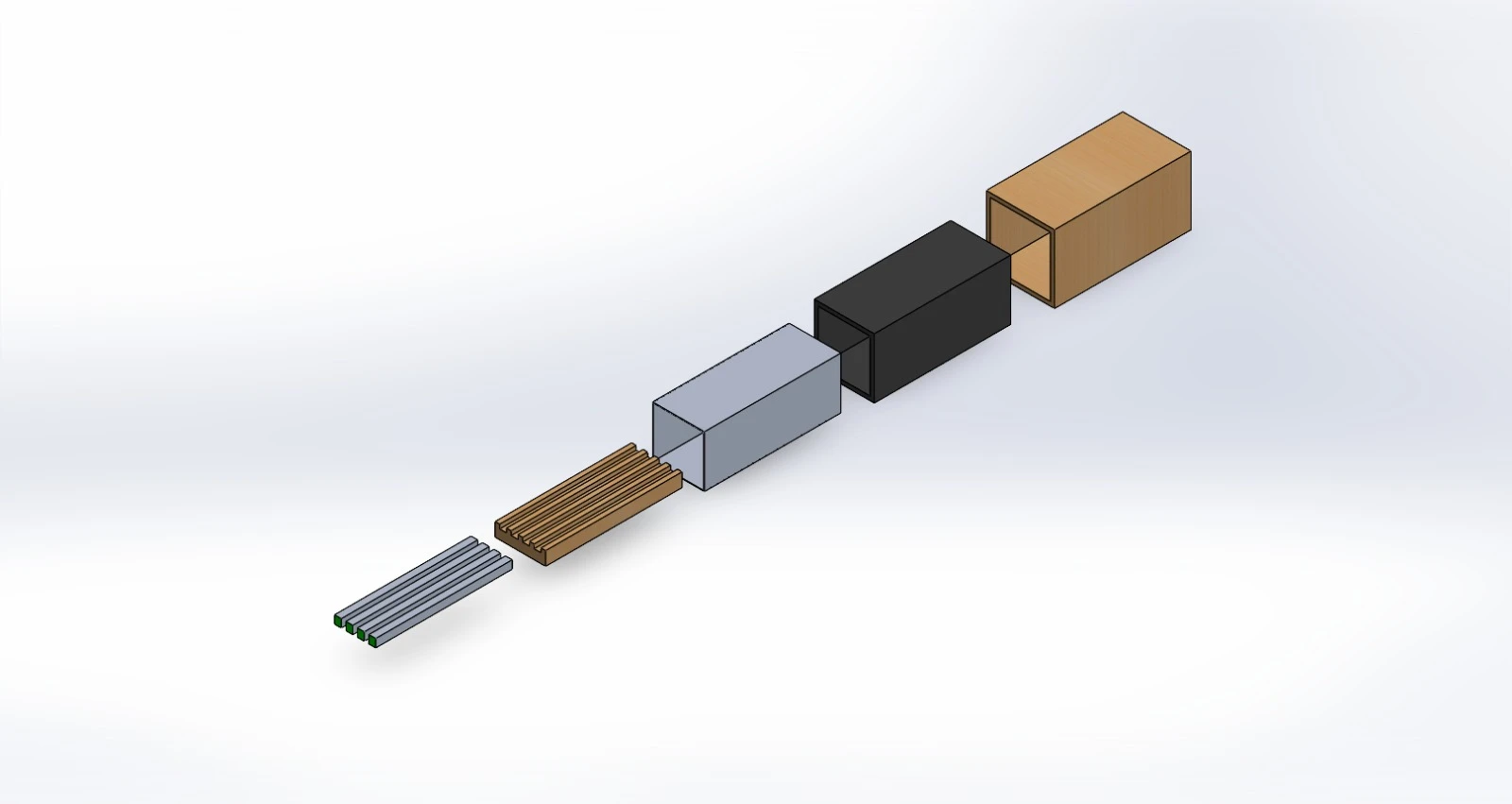
Phase-change material, or PCM, absorbs heat as it melts. A protective shell and insulation reduce the rate at which that stored cooling capacity is used.
The result is a thermal buffer. It is not a promise of indefinite cooling: the PCM must be recharged below its solidification temperature before reuse.
Every layer.
A reason.
A durable starting point.
The prototype uses moisture-resistant plywood for a locally fabricable outer structure. Seals and hardware are part of the design, with durability and cleaning to be validated.
An architecture
you can see through.
This exploded CAD view is part of the team’s supplied design material. It shows the physical layers behind the storage concept.
From a reading
to a useful decision.
The monitoring concept uses an ESP32 and a temperature / humidity sensor. Phone-based notification workflows and spoilage-risk models are development priorities.
Sense
Read internal temperature and relative humidity.
Understand
Evaluate conditions against a crop-specific test protocol.
Notify
Develop practical alerts that prompt a quality check.
Decide
Support the grower’s judgement alongside market conditions.
Monitoring and notification workflows are under development. Alerts do not guarantee produce safety, shelf life or selling prices.
Good engineering
asks what comes next.
How is the PCM recharged?
PCM needs to be cooled below its solidification temperature. Hot nights may prevent passive recharge. The team is evaluating practical recharge and panel-swap approaches; any external cooling and transport energy belongs in the full-system energy assessment.
Is this evaporative cooling?
The supplied prototype design centres on PCM and insulation. Evaporative cooling uses water evaporation to remove heat and depends strongly on humidity. It is a separate principle for future evaluation, not a verified feature of the current prototype.
Does it use zero energy?
Passive heat absorption inside the crate does not require a compressor. Electronics still need power, and PCM recharging may require external energy. We describe the whole system as a low-energy design ambition, not a verified zero-energy system.
What performance can be expected?
Temperature, hold time and produce quality must be measured for the selected crop, load, ambient conditions and PCM charge. Numerical design targets are not established field results.
Better questions.
Better engineering.
Help us turn an ambitious concept into reliable evidence.
Start a conversation