Build. Test.Listen. Improve.
The most important output of a prototype is what it teaches us. Our next phase centres on repeatable tests, useful data and real operating conditions.
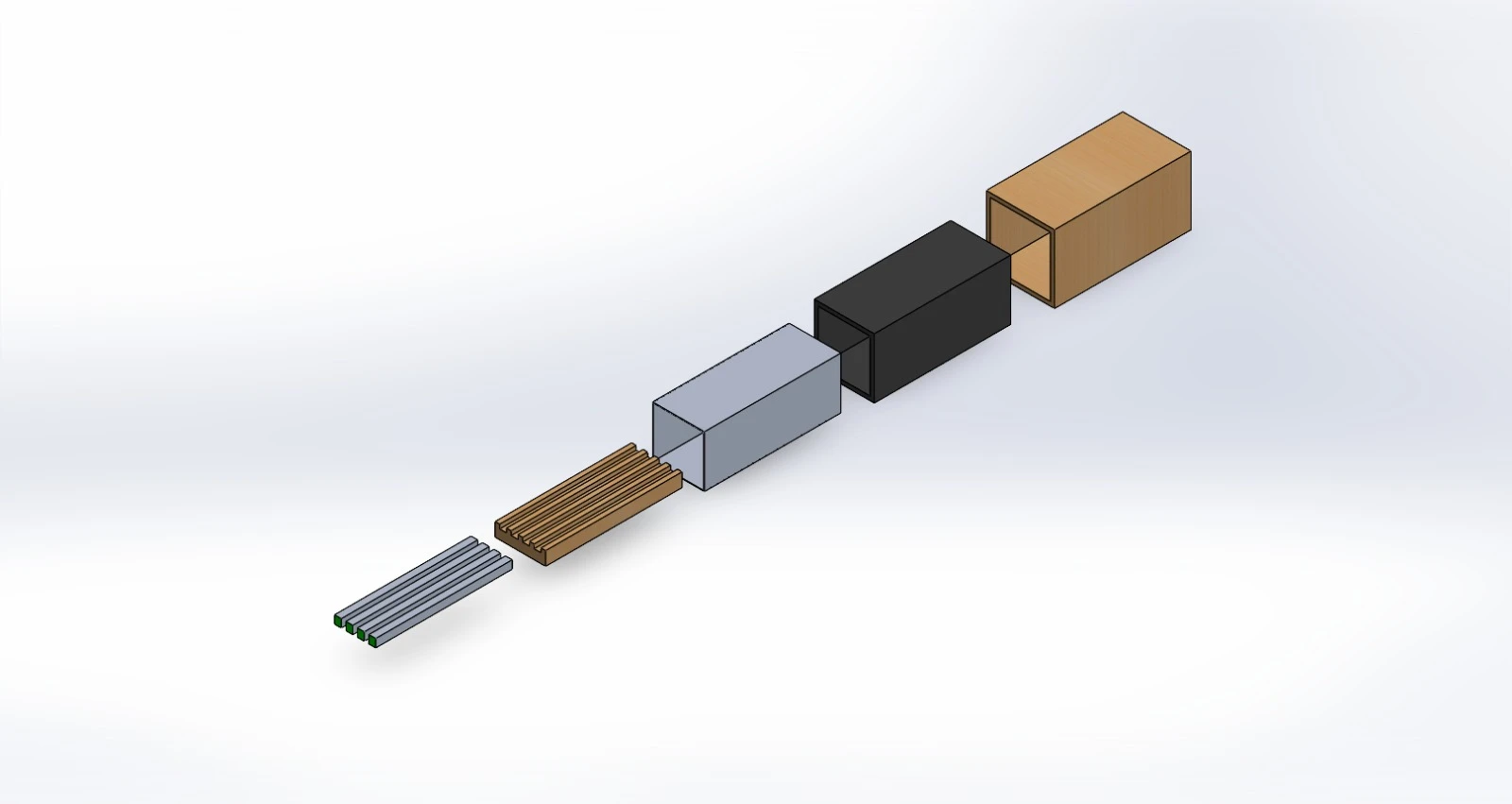 ASSEMBLY / CONCEPT STUDYR&D
EC.01
Different disciplines.
One connected system.
Mechanical engineering
Structure, CAD development, lid sealing, heat transfer, thermal analysis and physical durability.
Chemical & materials engineering
PCM selection, containment, material compatibility, moisture control and safe handling.
Software & sensing
Sensor readings, data logging, low-power operation, connectivity and planned notification workflows.
An idea.
Several perspectives.
Explore the design, its individual layers, and the questions behind the next iteration.
Supplied team CAD · Concept architectureBring the pieces together.
CAD lets the team study how the shell, insulation and internal components relate before refining the physical prototype.
ENGINEERING IN PROGRESSA better prototype.
A stronger proof.
This is the proposed development sequence. Timing and pilot scope will be confirmed with the team and field partners.
- 01 / DESIGN
Refine & instrument
Review the specification, calibrate sensors and document a repeatable test protocol.
OUTPUT: controlled design + test plan - 02 / BENCH TEST
Measure the thermal cycle
Log ambient and internal temperature, PCM recharge, loading, lid openings and humidity.
OUTPUT: traceable thermal records - 03 / FIELD TRIAL
Compare real outcomes
Use matched crops and a control group to study quality, handling, durability and user routines.
OUTPUT: crop-specific evidence - 04 / ITERATE
Improve with evidence
Review measured results, costs, failure modes and user feedback before a broader deployment.
OUTPUT: revised design + operating guidance
Useful data.
Honest answers.
We will report the conditions behind a result, not just a headline number.
Thermal performance
Measure internal versus ambient temperature over time, with PCM charge state, crop load and lid opening events recorded.
Recharge & whole-system energy
Assess the practical recharge method and include electronics, any external refrigeration and panel transport in the energy boundary.
Produce quality & loss
Compare marketable mass and quality with a matched control. Evaluate each crop separately, with sample size and test duration disclosed.
Materials, cleaning & service life
Check water exposure, leakage, repeated handling, food-contact separation, cleanability and component replacement.
Usability & affordability
Ask growers and operators what they can maintain, how they use alerts, and what operating model is practical.
Help turn good questions
into useful evidence.
Let’s grow something
that lasts.
A better post-harvest future starts with the right conversations.
Start a conversation